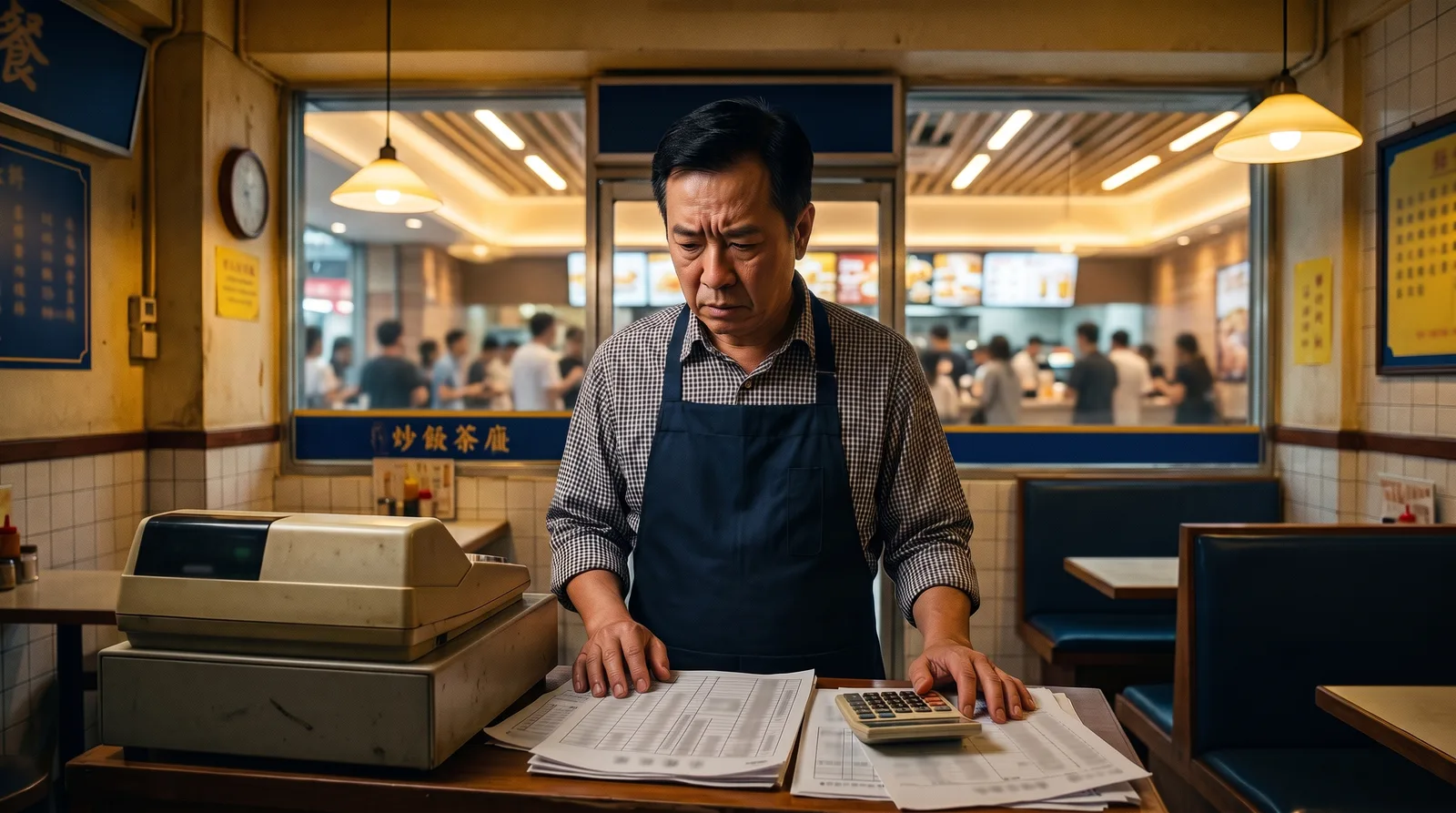
More than 2,000 Hong Kong restaurants shut in the past year; in the first four months of 2026 alone, 14 long-standing Cantonese establishments closed, some 60 and 67 years old. Each time an institution folds, the first reaction on the street is the same: "Rent, obviously."
That answer might have been right in 2019. Today, if you still think rent is the number-one culprit, you may be reading the wrong line. The real base layer of the closure wave isn't rent — it's that your biggest cost line has quietly become labour, and you may never have calculated what share it actually is.
Key Takeaways
- Latest results from Café de Coral and Fairwood: staff cost is about 35% of operating cost — the single biggest of the three major cost lines; rent is the smallest (~10–15%) and has actually eased below pre-pandemic levels.
- Café de Coral's labour share has risen 6 percentage points over ten years.
- Three 2026 policies — the "468" continuous-contract rule (18 Jan), the minimum wage rising to HK$43.1 (1 May), and the tightened Supplementary Labour Scheme (16 Jun) — all land on the same line: labour.
- The big chains cope because they use automation and data to cut staff cost 6.4% / 3.7% year-on-year in half a year. The gap isn't size — it's visibility.
1. Rent is no longer your biggest line
Start with the fact most operators get wrong: for Hong Kong's largest chains, staff cost is now the biggest expense — not rent.
Look at the numbers. Per Hong Kong Commercial Daily's breakdown of Café de Coral and Fairwood's latest results, staff cost is roughly 35% of operating cost at both — the largest of the three big lines (labour, ingredients, rent). Ingredients and packaging sit around 30% and have been fairly stable. Rent is the smallest, about 10–15% of total cost, a ratio that has barely moved for years and is actually lower than before the pandemic. Café de Coral's labour share is up 6 points versus ten years ago.
Note who these are: the most scaled operators in Hong Kong, with the strongest hand to negotiate rent. If even their labour has climbed to 35% and become the biggest line, your small shop — no scale, no group purchasing, no automation — feels the labour pressure even more directly. (For how the big chains still have room to talk down rent and speak of "cost structure," see The Big-Chain Jargon That's Really About Numbers You Can't Calculate.)
In other words: while you're staring at rent trying to save, the real hole is on the labour side.
2. Three 2026 moves, all pushing labour up
If hiring has felt more expensive and harder this year, it's not your imagination. The government made three moves in 2026, all landing on labour:
| Policy | Effective | What it means for your shop |
|---|---|---|
| "468" continuous-contract rule | 18 Jan 2026 | The part-time/casual threshold dropped from the old "418" to "468": employed 4 straight weeks and working ≥17 hrs/week, or ≥68 hours aggregated across the 4 weeks, now counts as a continuous contract — with paid annual leave, sick leave and statutory holiday pay. Keeping casuals just under the hours line to avoid benefits no longer works. |
| Minimum wage → HK$43.1 | 1 May 2026 | Up from HK$42.1, a 2.38% rise. The government calls the overall impact mild (~0.01–0.03% of total payroll citywide) — but that's the citywide average. For a restaurant where labour is already 30%+, a rise on your biggest line is anything but mild. |
| Supplementary Labour Scheme tightened | 16 Jun 2026 | Catering is the first sector into "Tier 2" vetting: the local-to-imported ratio tightened from 2:1 to 3:1 (three local full-timers per imported worker), the local recruitment window extended to 6 weeks, plus a fortnightly job fair. Catering is a heavy user of imported labour (~38% of all applications), so this cuts straight at you — importing is harder and pricier, pushing you toward costlier local hires or short staffing. |
All three point the same way: your biggest cost line only goes up this year.
3. Why do the big chains cope? Because they can see it
One more detail in those results: in the first half-year, Fairwood and Café de Coral cut staff cost 6.4% and 3.7% year-on-year through automation and digitalisation.
Why can they do it when many small shops can't? Not because their outlets are bigger, but because they can see and measure — labour as a share of sales at each outlet, which shift bleeds, where a system can pick up the slack. You can only fix what you can see.
Small operators aren't unwilling to save; they simply can't see where the money leaks. By the time the month-end books reveal labour overran, the month is already lost.
4. Can you calculate your shop's labour-cost ratio?
The number the chains watch daily is the labour-cost ratio:
Labour-cost ratio = total staff cost ÷ revenue
"Total staff cost" isn't just base pay — include MPF, paid leave, overtime, bonuses and allowances, i.e. after "468", a batch of part-timers whose benefits now count too.
An example: say you do HK$500,000 in monthly sales, and all staff cost (with MPF, leave, overtime) comes to HK$175,000 — your labour-cost ratio is 175,000 ÷ 500,000 = 35%. If ingredients are another 30% (HK$150,000), your Prime Cost = 65%, leaving 35% for rent, utilities, sundries and your own profit. If rent takes 15% (HK$75,000), you're left with 20% for everything else — tight, and obvious the moment you see it. (For moving food cost from guessing to calculating, see Restaurant Cost Control: 4 Decisions to Bring Food Cost from 41% Down to 30%; for how much rent should be, see The Deluxe Restaurant Lesson.)
The problem: many operators have never calculated that 35%, so they don't know if they're near the warning line or already past it. When three policies land, if you don't know where your line sits, you don't know whether you're bleeding or holding.
5. How our system helps
What InvSpot does is put your cost structure in front of you in real time — food-cost ratio, contribution per dish, which line dominates your spending — without waiting for month-end. When labour pressure comes in waves, you at least know immediately: is there room left to tighten on ingredients, how much buffer you have, which decision actually saves the line.
We won't roster your staff or run payroll — but when you have to choose between raising prices, cutting hours or trimming ingredients, you need real numbers, not guesses. See your cost structure, and you move from surviving to choosing.
The bottom line
Of the 2,000-plus restaurants that closed in the past year, not all had slow business. Many traded on while bleeding, unaware, until the cash ran dry. The real difference between the chains and the small shops isn't size — it's visibility.
The three moves are already in force; labour only gets more expensive from here. Calculate your labour-cost ratio, see your cost structure, and you get to choose, negotiate, and hold on.
Want to see your own shop's cost structure clearly? See how we do it, or talk to us.
FAQ
What is the "468" continuous-contract rule, and how does it affect restaurants?
"468" is a new employment rule effective 18 January 2026, replacing the old "418". An employee engaged by the same employer for 4 or more consecutive weeks, working at least 17 hours a week or at least 68 hours aggregated over the 4 weeks, is treated as being on a continuous contract — entitled to paid annual leave, sick leave and statutory holiday pay. For restaurants that rely on many part-timers and casuals, more staff now carry benefits, raising actual labour cost.
How much did Hong Kong's minimum wage rise in 2026?
From 1 May 2026, the statutory minimum wage rose from HK$42.1 to HK$43.1 per hour, a 2.38% increase — the first adjustment under the new annual-review mechanism.
What percentage of revenue should restaurant labour cost be?
There's no universal figure, but for reference: Hong Kong's large fast-food chains (Café de Coral, Fairwood) run staff cost at about 35% of operating cost. With ingredients (typically ~30%), Prime Cost generally needs to stay below 65% of revenue for healthy margins. The key is to calculate your own number first, so you know how close you are to the warning line.
With the imported-labour scheme tightened, can I still hire?
Yes, but under stricter conditions. From 16 June 2026 catering falls under Tier 2 vetting: the local-to-imported ratio tightened to 3:1 and the local recruitment period extended to 6 weeks. It isn't a suspension — but the threshold and cost of importing labour are both higher, keeping local staffing tighter.
Sources
- Hong Kong Commercial Daily — restaurant cost-structure analysis (Café de Coral / Fairwood): Hong Kong Commercial Daily
- GovHK 1823 — Continuous Contract & the "468" rule: GovHK 1823
- Labour Department — Statutory Minimum Wage: Labour Department
- GovHK press release — ESLS review results and enhanced measures (2026-06-15): GovHK press release
- Hong Kong Free Press — "Hong Kong tightens labour import scheme rules for catering industry" (2026-06-16): HKFP
- Food and Environmental Hygiene Department (FEHD) licence data; Vision Times — H1 2026 Cantonese closures reporting