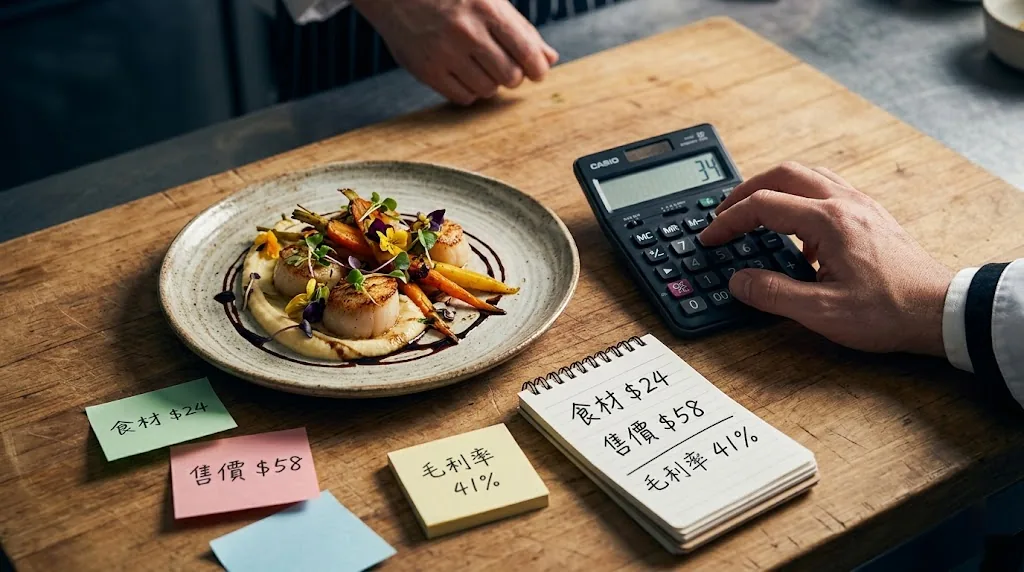
Cost control is the lifeblood of a restaurant business, yet most owners only ever see the tip of the iceberg. Think a dish costs $20, so selling it at $58 means you're laughing? Add in ingredient wastage, sauces and seasoning, side garnishes, cooking oil and portion drift, and the true cost can easily be $24.
That $4 gap looks small. But sell a few hundred plates a month, multiply across the dozens of dishes on your menu, and the profit you've lost will give you a shock.
This article shows you how to go from guessing your costs to actually calculating them — and what decisions you can make afterwards to lift profit. The first step in restaurant cost control isn't saving money — it's seeing clearly where the money goes.
Key Takeaways
- The first step is seeing, not saving: shift from guessing your costs to calculating them, so you know where the money actually goes.
- True cost runs higher than you think: a dish you assume costs $20 really costs $24 once wastage, sides and seasoning are counted — pushing the ratio to 41%.
- The healthy band is 28%–35%: cross that line and even a queue out the door earns only hard-won dollars.
- 4 decisions bring it back to 30%: reprice, swap ingredients, change suppliers, and do menu engineering.
Why Guessing Your Costs Is a Restaurant's Biggest Blind Spot
Most owners costing a dish only count the main ingredients — a steak, a portion of pasta. But the true cost goes far beyond that. The most commonly overlooked items are these:
- Ingredient wastage: trimming and peeling, burnt dishes, expired stock thrown out, mis-fired orders — it's all money. Fillet a whole fish and you may be left with only 60% you can actually sell.
- Sides and sauces: mash, salad, house-made sauces, that little dish of pickles on the table — small amounts that add up to something substantial.
- Seasoning and cooking oil: frying oil, salt, sugar, soy sauce — tiny per plate, but multiply by a few hundred plates and it's not tiny at all.
- Inconsistent portions: a chef with a heavier or lighter hand can shift the cost of the same dish by two or three dollars.
- Supplier price swings: vegetable, meat and seafood prices move with the seasons and the market — last month's cost figure may already be wrong this month.
The result: you think your food cost ratio is 30%, but calculated properly it may be 38% or even higher. It's not that you aren't making money — it's that you genuinely don't know whether you're making money or losing it.
How Do You Calculate the True Cost? The Formulas, Spelled Out
To get restaurant cost control right, you first need to know how to calculate two numbers.
First, the true cost per dish:
Cost per dish = total ingredient usage × purchase unit price, divided by the number of portions you can actually serve (wastage included)
Don't just count what you spent on stock — count how many plates you actually got out of it. Buy $480 of beef and, after wastage, plate up 20 portions, and your beef cost is $24 per dish — not the prettier number the "theoretical portion size" would give you.
Second, the food cost ratio (Food Cost %):
Food cost ratio = cost per dish ÷ selling price × 100%
Back to the example at the top: a dish selling at $58 with a true cost of $24 has a cost ratio of around 41% — clearly on the high side.
The industry generally keeps the food cost ratio between 28%–35% (it varies by cuisine and positioning). Cross that line, and even with a queue out the door, every dollar you earn is hard-won.
Once You've Calculated Your Costs: 4 Decisions You Can Make
Knowing your true cost isn't the finish line — it's the starting point. With accurate numbers, your decisions move from gut feel to data.
1. Reprice
Work backwards to the price that hits your target cost ratio. If a dish truly costs $24 and your target cost ratio is 32%, the sensible selling price is around $75 — not $58.
2. Swap Ingredients
Find substitutes of similar quality at a lower price. Swap an imported vegetable for a local, in-season one, say — the taste is much the same, but the cost drops immediately.
3. Change Suppliers, or Negotiate
With clear purchasing data, you can see which supplier has been consistently expensive over time. Walking into a price negotiation holding numbers is far more persuasive than empty talk.
4. Do Menu Engineering
Dishes that are high-margin and popular get prime placement and a hard push; dishes that are expensive and rarely ordered get reworked or taken off the menu. A menu's profit is usually built out of exactly these trade-offs.
See Your Costs in Real Time, With AI — No Waiting for Month-End
Everything above is hard for one reason: you need to track the price of every ingredient and the cost of every dish continuously, accurately and in real time. Manual entry in Excel falls behind fast — especially once you have dozens of dishes and hundreds of ingredients. That's the step InvSpot handles with AI: scan a delivery invoice and the system computes each dish's true cost and your live food cost ratio — no Excel, no accountant — so you see the bleed while there's still time to fix it.
Whichever system you choose, it should at least do the following:
- Log purchase prices and price movements automatically — when a supplier raises prices, you find out without waiting for the month-end statement.
- Calculate each dish's true cost automatically from the recipe — wastage and portion drift included, no punching a calculator every time.
- Compare prices across suppliers — see at a glance where the same ingredient is cheaper to buy.
- Flag dishes whose cost ratio is over the line — an alert the moment something goes wrong, not at month-end.
The point isn't which tool you use — it's whether your tool can actually do the things above, i.e. whether you can see your costs in real time. Once you can see them, you stop guessing and start deciding from the numbers.
FAQ
My shop is tiny — do I really need cost control?
The smaller you are, the more you need it. Big groups can afford trial and error; for a small shop, losing tens of thousands of dollars in a month really hurts. The sooner you get the numbers straight, the sooner you stop the bleeding.
Is a lower food cost ratio always better?
No. Push it too low and portions and quality drop with it — customers can taste the difference, and it drives them away. The goal is a reasonable ratio, not the lowest one; 28%–35% is usually the healthy range.
Ingredient prices move all the time — what's the point of calculating?
Precisely because they move all the time, you need to track them. The point isn't a one-off calculation — it's watching the changes continuously and adjusting pricing and purchasing as they happen. That is exactly where a tool (such as InvSpot) is much faster than doing it by hand.
Conclusion: Stop Running the Business on Gut Feel
Restaurant profit is often lost not to slow business, but to not knowing you're losing money. (That's exactly what most of the closures in the closure wave had in common — not empty tables, but not seeing the bleed in time.) You think a dish is profitable when its cost ratio is actually too high; you think a supplier is a good deal when they've been raising prices year after year.
Calculate your true costs first, then decide on pricing, ingredients and suppliers — that is the core of restaurant cost control. With clear numbers, repricing, swapping ingredients or changing suppliers stops being a gamble and becomes a decision you can test and measure.
Start today: pick the signature dish you're most confident about, sit down properly, and work out its true cost — wastage and sides included. What you find might just shock you.