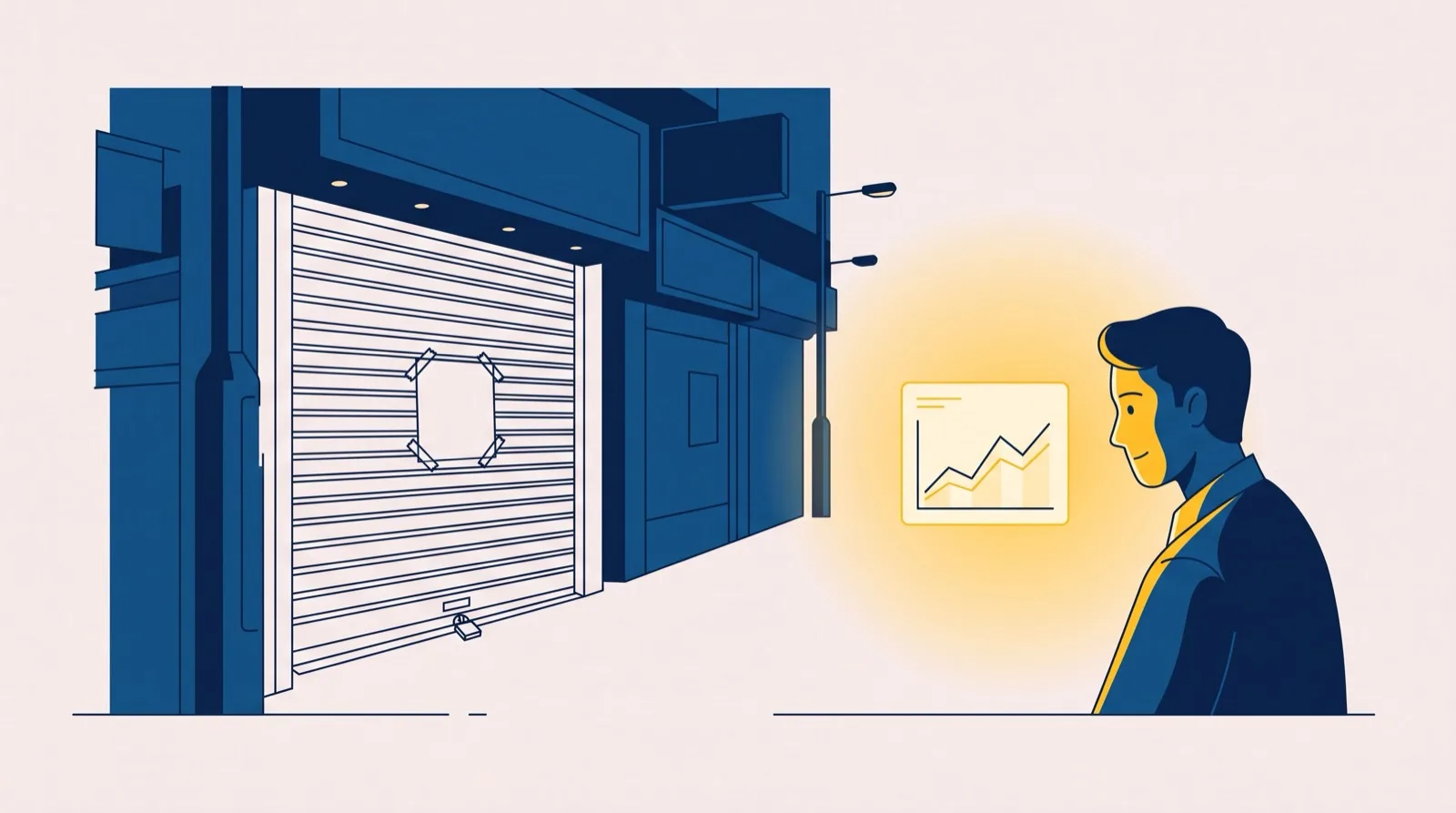
Walk through Mong Kok, Kwun Tong or Tsuen Wan lately and you'll pass shuttered shopfronts with a hand-taped note: "Thank you for years of support." Easy to think: tough market, not my problem.
If you run a restaurant yourself, don't turn the page so fast. Because when you actually look at which places closed and why, an uncomfortable pattern emerges — they didn't die from empty tables. They died from not seeing the bleed until the cash ran out.
This isn't another "isn't it sad" piece. It's a clear breakdown of how real the closure wave is, how these places actually failed, and — if you don't want to be next — the numbers you need to be watching today.
Key Takeaways
- 2,000+ closed in a single year. As of 30 April 2026, Hong Kong had 17,154 restaurant licences on record (FEHD) — 255 fewer than a year earlier. Over 2,000 closed in the period against just 1,779 new openings. And it wasn't only the old shops.
- Heritage houses and new shops died together. Fourteen heritage Cantonese restaurants closed in the first four months of 2026 (some 60 and 67 years old); Kwun Tong alone saw 6+ eateries close within weeks — from a 70-year-old to a ramen shop less than a year old.
- The common thread wasn't slow business. Even in the US, 42% of restaurant operators weren't profitable in 2025 (National Restaurant Association). Closures usually don't start losing at the end — they lose the whole time, unseen.
- Survivors watch 3 numbers: Prime Cost, food cost %, and break-even. Nothing exotic — just the most basic question of all: am I making money this month, or losing it?
How real is the closure wave? Look at the numbers, not the vibe
The numbers are plain. FEHD data shows 17,154 restaurant licences as of 30 April 2026, 255 fewer than a year before — over 2,000 closures against 1,779 openings. More closing than opening. Property advisory JLL calls it "a reset and a survival-of-the-fittest process." The Standard and SCMP report the same story: under weak spending, northbound dining and inflexible landlords, closure has gone from headline to routine.
| Where / who | Age | Why it closed |
|---|---|---|
| Heritage Cantonese houses (Kwai Fong, Ngau Chi Wan, etc.) | 60–67 years | Weak spending, inflexible landlords, cross-border dining, emigration (Vision Times) |
| Kwun Tong cluster (6+ eateries) | From 70 years to under 1 year | All naming the same trio: high rent + rising ingredient costs + weak demand (Dim Sum Daily) |
| Congee chain (all outlets) | 33 years | Cash flow collapse, unpaid wages |
| A roast-meat / cha chaan teng group | Multiple branches | Closed 9 at once; 100+ staff affected; over HK$1M in wages owed |
Notice: age isn't a moat. In the Kwun Tong cluster, a 70-year-old beef-noodle shop and a ramen bar less than a year old closed side by side.
Why they closed — the common thread wasn't "no customers," it was "couldn't see it"
You might think: so it's just a weak market, no customers. Here's a counter-intuitive data point. The US National Restaurant Association found that even in America — a bigger, more tech-mature market — 42% of operators weren't profitable in 2025. If that's true where the infrastructure is strong, the Hong Kong independent still doing the books on paper has even less chance of seeing where they really stand.
(One Singapore F&B advisory put it even more starkly, reckoning as many as 82% of the outlets that closed there had never turned a profit — a practitioner's estimate rather than a formal study, but it rhymes with the NRA figure.) These operators weren't trading fine and suddenly losing — they were losing the whole time, and the owner either couldn't see it or wouldn't believe it.
That's the real logic underneath a closure wave. Many owners judge "how's the shop doing?" by how full it looks tonight and how thick the till is. But full tables aren't profit: if every dish is losing money or barely breaking even, selling more just makes you poorer faster.
What actually kills a restaurant isn't one slow night. It's small daily losses, unnoticed for months — until one day the rent can't be paid and payroll won't clear. By then it's too late.
Don't want to be next? The 3 numbers to watch today
1. Prime Cost (food + labour as a % of sales)
Prime Cost = (food cost + labour cost) ÷ sales. These are a restaurant's two biggest expenses; the trade generally keeps this under 60–65% of sales. Cross the line and even a queue out the door earns you next to nothing. If you can't produce this number, you're driving with no fuel gauge.
2. Food cost percentage
Food cost % = food cost ÷ sales; a healthy range is roughly 28–35%. Plenty of owners assume they're at 30% and, costed properly (including waste, garnish and sauces), are actually north of 38% without knowing. For how to move from guessing to calculating, see our post Restaurant Cost Control: 4 Decisions to Bring Food Cost from 41% Down to 30%.
3. Break-even
The monthly sales you must hit just to break even. Know this line and you know whether the month is safe or dangerous, and by how much. Many closed shops couldn't answer, to the very end, how much they needed to make to cover rent — the most dangerous blind spot of all. (For how much rent should be, see The Deluxe Restaurant Lesson.)
What these three share: they only help if you can see them in real time. Wait until month-end close and you've already lost the whole month. The ones who fell in this closure wave didn't lack skill — they saw the numbers too late.
What our system does: makes it visible in real time
What InvSpot does is turn these numbers from "calculable at month-end" into "visible every day." Scan a delivery invoice and the system computes each dish's true cost, your live Prime Cost, food cost % and break-even — no Excel, no waiting on the accountant. The goal is simple: show you the bleed while there's still time to fix it, not after payroll bounces.
We won't tell you a tool guarantees you'll never close — no one can. But at least you won't be the owner who was losing money the whole time and never knew.
The bottom line
A closure wave isn't a natural disaster. It's a brutal filter: those who can see their numbers hold on; those who can't get their turn eventually.
You don't need to start with anything complex. Today, take your most confident signature dish and cost it properly — waste included — then compare it to the price. If even that one barely breaks even, what about the rest?
You can only save what you can see.
FAQ
When will Hong Kong's restaurant closure wave end?
No one can call it precisely, but the underlying pressures — high rents, northbound spending, weak consumer sentiment — are structural and unlikely to reverse soon. Rather than wait for the market to turn, put your attention on what you control: your cost line. You can't change the market, but every dollar of cost is yours to decide.
Why are so many restaurants closing?
On the surface: high rent, weak trade, cross-border spending. But the deeper common thread is that many that closed had never truly turned a profit — the owner simply couldn't see the losses. Rent and the market are external pressure; not seeing your costs is what's fatal.
What are the warning signs before a restaurant closes?
The most common sign isn't "no customers" — it's "tighter and tighter": business looks OK, but month-end always comes up short, rent gets harder to cover, and cash flow leans on delayed payments and personal funds. Those are the signals of slow, steady losses. If you can't say whether your shop made or lost money this month, that itself is the biggest red flag.
Do small shops need to track costs?
The smaller you are, the more you need to. Big chains can absorb mistakes; a small shop losing tens of thousands in a month feels it hard. The sooner you have the numbers, the sooner you stop the bleeding.
Sources
- Food and Environmental Hygiene Department (FEHD) restaurant-licence data; JLL commentary — per Hong Kong press reporting
- Vision Times — "Hong Kong's Cantonese restaurant industry is collapsing: 14 closures in the first four months of 2026" — Vision Times
- Dim Sum Daily — "Kwun Tong hit by restaurant closures" — Dim Sum Daily
- The Standard — "Restaurant closures surge as Hong Kong faces spending slump" — The Standard
- SCMP — "Hong Kong restaurateurs revamp traditional dining as closures reshape industry" — SCMP
- US National Restaurant Association — 2026 State of the Restaurant Industry (42% of operators not profitable in 2025)
- Singapore "82% of closures never profitable" — a practitioner's observation (informal), My Restaurant Strategist (LinkedIn)