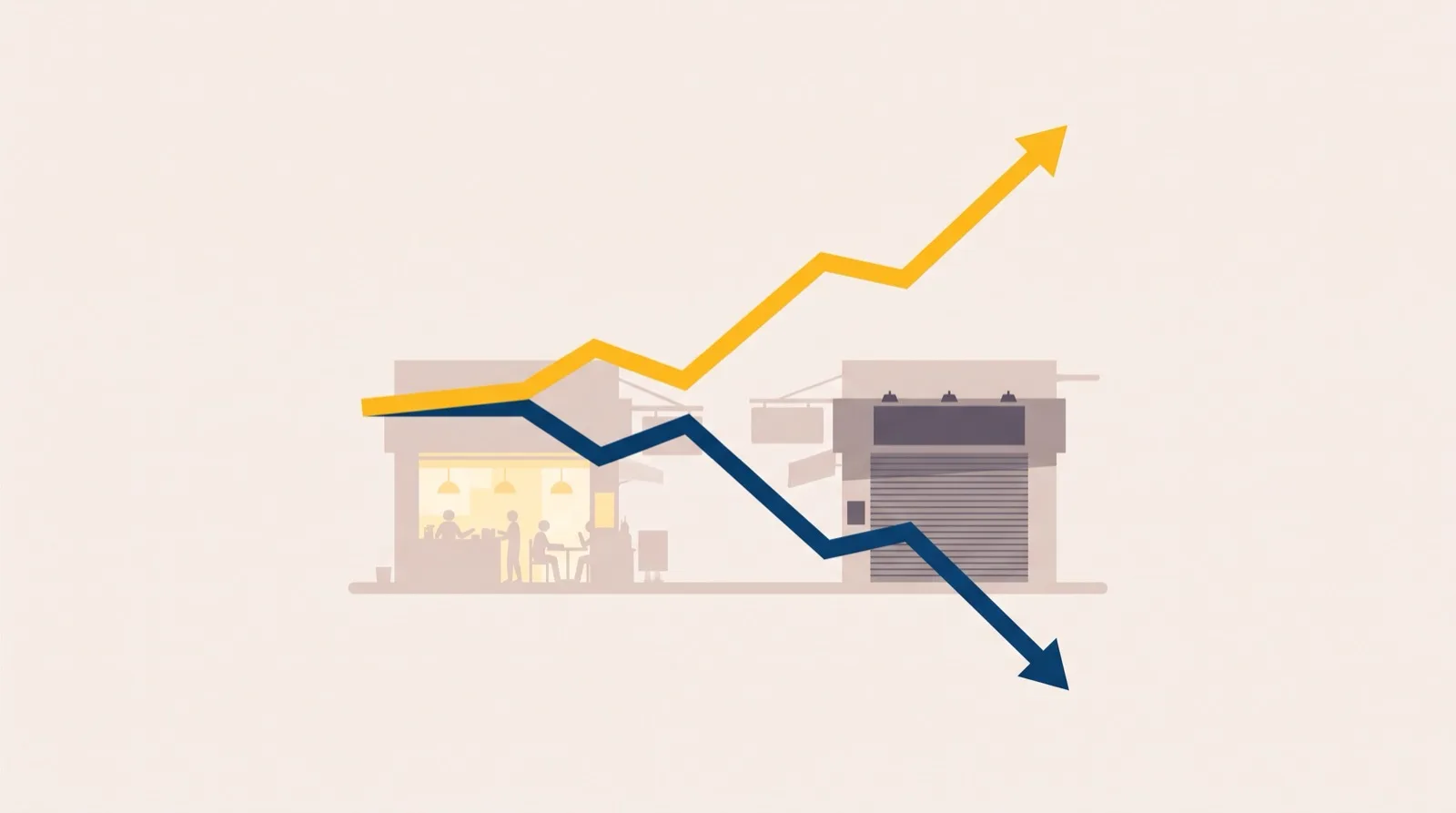
Lately you may be hearing two opposite stories. On one side, Mastercard says Hong Kong dining spend rose 14.2% in Q1 2026, and the government calls restaurant business "continuing to improve." On the other, your shop — and the old-timers down your street — feel nothing like a boom, and if anything are working harder for less.
Who's lying? Neither, actually. The question isn't "is the market good?" It's that the market has split in two — and the average is sitting right on top of the side you're standing on.
Key Takeaways
- Total up, Chinese down. Mastercard data: HK dining spend +14.2% YoY in Q1 2026 — but the same analysis shows traditional Chinese restaurants roughly 24% below 2018.
- The official number is harsher. Legislative Council Secretariat research: Chinese-restaurant Q1 revenue fell from HK$13.44B (2018) to HK$9.7B (2026) — down 27.9% — while non-Chinese restaurants rose 10.9%. Cantonese was hit hardest.
- This is a K-shaped split. The money didn't vanish; it changed direction — up for premium, international and fast food; down for mid-tier Cantonese and cha chaan tengs. You're not "rising with the market" — you're on one of two lines.
- The average is a trap. The operator who hears "dining is up 14.2%" and relaxes is the most exposed. A rising market doesn't mean you're rising. Which side you're on — and how far from the edge — only your own numbers can answer.
How can "up" and "down" both be true?
Start with the data. The Mastercard Economics Institute reported HK dining spend up 14.2% YoY in Q1 2026 — but the growth came mainly from more affluent, experience-led spenders shifting from goods to dining and leisure. Break it down: non-Chinese restaurants and fast food are above 2018, but traditional Chinese restaurants sit about 24% below it.
The Legislative Council Secretariat's research is blunter still: Chinese-restaurant Q1 revenue fell from HK$13.44B in 2018 to HK$9.7B in 2026 — down 27.9% — while non-Chinese restaurants rose 10.9% over the same period. Cantonese cuisine was the hardest hit.
| Which side | Performance | Typical |
|---|---|---|
| The upward line | Non-Chinese +10.9% (official); fast food, international, premium strong | High-spend experiences, tourists, affordable chains |
| The downward line | Chinese restaurants −27.9% (official); Cantonese worst | Mid-tier Cantonese, cha chaan tengs, heritage houses |
Economists call this a K-shaped split: not everyone rising or falling together, but one line up and one line down, splitting apart in the middle. The mid-tier local restaurant InvSpot serves — the one you likely run — is often on the lower line.
The average is a gentle trap
The dangerous thing about "dining spend is up 14.2%" isn't that it's wrong — it's that it lets an operator standing on the losing side exhale.
You hear "the market is recovering" and figure you can hold on a little longer. But if your shop is on the downward line, you're not waiting for a recovery — you're waiting for the next rent increase and the next loss-making month. The average won't come to save you; it will only make you notice the trouble one step later.
The real question was never "is Hong Kong dining healthy?" It's: is my shop making or losing money this month, and which line am I on? No citywide average will ever answer that. Only your own numbers will.
Don't want the average to fool you? Get 3 things straight first
1. Your own trajectory (not the city's)
Don't use headlines as your dashboard. Look at your own last few months — revenue, average spend per cover, gross margin: rising or falling? That line is yours. Many closed shops only discovered at the end that their line ran opposite to the market's.
2. Has your cost ratio fallen with sales?
Even if sales drop, you can survive if costs stay controlled. The trap is that when sales fall, the cost ratio often rises (fixed costs unchanged, portions and waste as before). For how to calculate and cut food cost %, see Restaurant Cost Control: 4 Decisions to Bring Food Cost from 41% Down to 30%.
3. Your break-even point
Know how much you must make in a month just to break even, and you know how far you are from the safe line. You can't control whether the market rises or falls — but this line you can defend. It's also the biggest difference, in the closure wave, between the shops that held on and the ones that didn't.
See your own line in real time, with AI
Seeing your own line is hard because it has to be real-time and accurate. Wait until month-end close and you may already have lost the whole month before you knew which side you were on. That's the step InvSpot handles with AI: scan a delivery invoice and the system computes your live cost ratio, margin and break-even — no Excel, no accountant — so you see which line you're on while you still have choices.
Once you can see it, you get to choose: reposition, defend margin, or pivot — each one a decision you can test and measure, instead of a bet on the citywide average.
The bottom line
Hong Kong dining isn't dead — it's split in two. Some are riding the 14.2% wave; others are inside the 27.9% fall. The divide isn't luck. It's who can see which line they're on, and moves while they still can.
You don't need the citywide numbers. You need one thing: whether your own shop, this month, is heading up or down.
FAQ
Is Hong Kong's restaurant industry actually recovering?
Depends which side you ask. Total spend (Mastercard +14.2%) and non-Chinese restaurants (official +10.9%) are up; but official figures show traditional Chinese restaurants down 27.9%. So "recovery" is real for premium/international/fast food, and not so much for mid-tier Cantonese. Rather than ask the market, ask your own shop's line.
Why were traditional Chinese restaurants hit hardest?
Spending patterns shifted — diners heading north, chasing experience-led and international dining, and a changed tourist mix. Mid-tier Cantonese places also tend to carry high fixed costs (big rooms, more staff) and can't easily raise prices — squeezed from both ends. It's structural, not a blip.
The market's up but my shop is down — what can I do?
First, accept that "the market" and "your shop" are two different things — don't let headlines comfort you. Then read your own revenue trend, cost ratio and break-even, and decide: defend costs, reposition, or pivot. With data, those are decisions; without it, they're guesses.
Sources
- Mastercard Economics Institute — HK Q1 2026 dining-spend analysis, reported by Dim Sum Daily — Dim Sum Daily
- Legislative Council Secretariat research (Chinese-restaurant revenue −27.9%, 2018 vs 2026), reported by SCMP — SCMP
- Food and Environmental Hygiene Department (FEHD) licence data (2,000+ closed in a year) — see the closure wave post