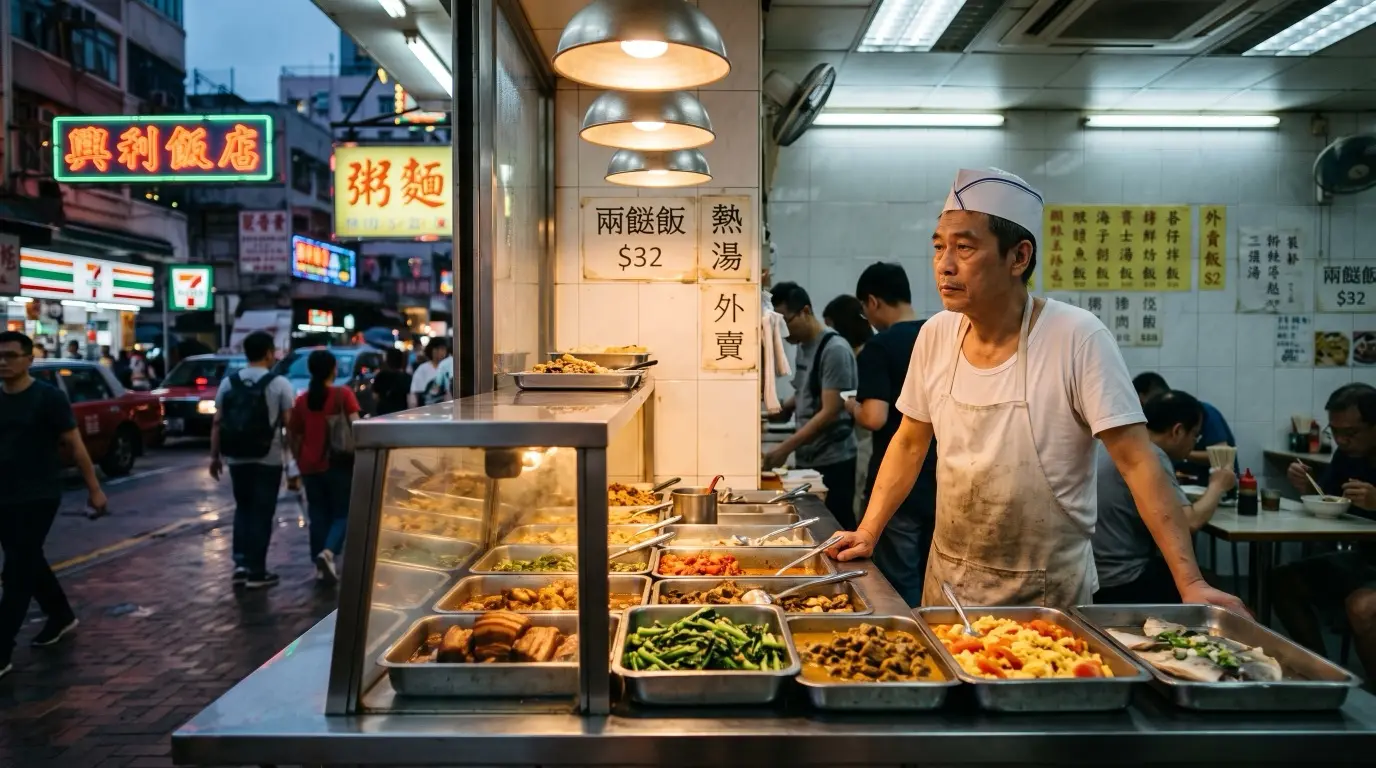
The same week brought two pieces of news from the two-dish rice world — and they could not have pointed in more opposite directions.
On one side, Loong Pak Mei's Causeway Bay branch — around HK$230k a month in rent, open less than a year — closed down. On the other, sector leader Ken's Fatt Kitchen moved into Mong Kok at HK$160k a month, opening yet another store.
One retreats, one advances. And two-dish rice — the "king of cheap eats" everyone assumed was the safest bet in a bad economy — turns out to be every bit as brutal.
Key Takeaways
- One retreats: Loong Pak Mei's Causeway Bay branch — around HK$230k a month in rent, roughly 1,300 sq ft — closed down after less than a year (the previous tenant in the same spot was Chow Sang Sang jewellery, which traded there for around 30 years at HK$300k a month).
- One advances: sector leader Ken's Fatt Kitchen took roughly 2,400 sq ft in Mong Kok at HK$160k a month; it now runs 7 stores across Hong Kong, paying over HK$1.19M in combined monthly rent.
- One number: at $40 a bowl of two-dish rice, rent alone means selling around 4,000 bowls a month — about 134 bowls a day — before a cent of food, labour or utilities.
- One lesson: cheap-and-high-volume means margins are thin to begin with, and price rises are off the table. A single percentage point of food-cost drift or wastage is enough to turn profit into loss. Cost control is the only line between life and death.
At $40 a Bowl, How Many Do You Have to Sell Just to Cover the Rent?
Take Ken's Fatt Kitchen's new Mong Kok store as the worked example: HK$160k a month in rent, $40 a bowl. Rent alone works out at HK$160,000 ÷ $40 = 4,000 bowls a month, or about 134 bowls a day.
And those 134 bowls cover rent and nothing else — not a dollar of food, a dollar of labour, or a dollar of electricity has been counted yet. To actually break even, the number of bowls you need to sell sits a long way higher.
That is the brutality of two-dish rice: the ticket is small, so the volume has to be huge before your fixed costs get spread thin enough. Fall just a little short, and the whole model comes apart.
Cheap Was Never a Moat
Look again at that Causeway Bay spot. The previous tenant was Chow Sang Sang — a jeweller — which traded there for around 30 years at HK$300k a month before moving out. The two-dish rice shop that moved in after it, at HK$230k a month, lasted less than a year.
Same shopfront. One lasted 30 years; the other, less than one.
The moment the economy turns, everyone's instinct says the same thing: going cheap must be safer. But two-dish rice margins are razor-thin to begin with, and the cheaper you sell, the less room you have to rescue yourself with price rises. Once the market softens and costs tick up, a thin profit flips straight into paying customers to eat. Cheap is not a moat; cost discipline is.
In a Thin-Margin Business, Every Percentage Point Is Life or Death
In a business running a 30% gross margin, a 3% rise in food cost is something you can ride out. In a business as thin as two-dish rice, the same 3% rise could be your entire net profit.
So the cheaper you sell, the more clearly you need to see:
- Which dish has quietly crept up in cost?
- Which day, and which store, wrote off how much?
- Which supplier's prices have moved?
In a thin-margin business, every dollar sitting in those gaps is your life.
What Our System Does to Help
InvSpot can't make your rent cheaper. But on thin margins, we make sure not a single dollar of cost slips past you unseen:
- Real-time food cost ratio: what a bowl actually costs and what percentage that takes — visible at any moment.
- Supplier price-rise alerts: which dish and which supplier quietly raised prices — you know the moment the invoice comes in.
- Contribution margin per dish: which dishes genuinely earn and which sell at a loss — with numbers to show it.
The winner in two-dish rice isn't whoever sells cheapest. It's whoever, at the same $40, knows most clearly whether they're making or losing money.
Low prices can rescue your footfall for a while. They can't rescue a set of books you can't see into.
In a world where the profit on a bowl is counted in cents, seeing clearly is the real moat.
Want to know how much a bowl of your rice is actually earning?
FAQ
How many $40 bowls of two-dish rice do you have to sell just to cover the rent?
Based on sector leader Ken's Fatt Kitchen's new Mong Kok store at HK$160k a month, selling at $40 a bowl means around 4,000 bowls a month — about 134 bowls a day — just to barely cover the rent, before food, labour and utilities.
Two-dish rice is so cheap — doesn't that make it a safer business?
Not necessarily. Two-dish rice margins are very thin to begin with, and the cheaper you sell, the less room you have to rescue yourself with price rises. Once the market softens or costs rise, a single percentage point of food-cost drift or wastage is enough to turn profit into loss. Cheap is not a moat; cost discipline is.
Why did Loong Pak Mei's Causeway Bay branch close in under a year?
Loong Pak Mei's Yee Wo Street store in Causeway Bay paid around HK$230k a month in rent for roughly 1,300 sq ft and closed after less than a year in business. The previous tenant was Chow Sang Sang jewellery, which traded there for around 30 years at HK$300k a month. On two-dish-rice margins, making the numbers work at that rent is extremely hard.
How can a thin-margin restaurant control costs?
Digitise your paper invoices, then watch your real-time food cost ratio, supplier price-rise alerts and contribution margin per dish, so every dollar is defended on thin margins. That is exactly what InvSpot does.
Sources
- Loong Pak Mei's Causeway Bay branch closes — open less than a year, monthly rent over HK$230k — Yahoo Finance HK (in Chinese)
- Ken's Fatt Kitchen moves into Mong Kok at HK$160k a month — how much two-dish rice covers the rent — 28Hse (in Chinese)