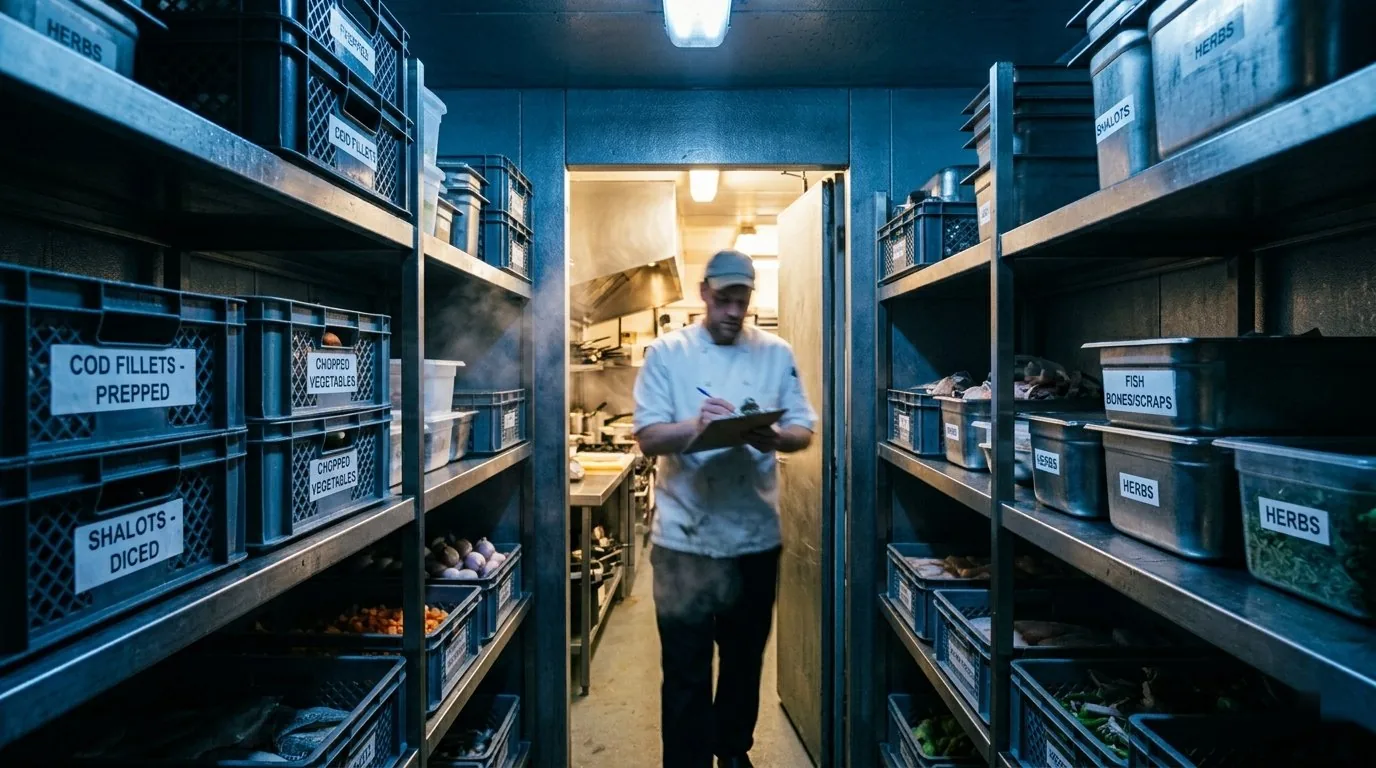
Plenty of restaurant owners assume that ordering more, in bigger batches, means discounts and savings. Then the month-end numbers come in: the fridge is packed solid, vegetables have rotted, frozen goods have passed their dates — and the write-offs can easily outweigh the little you saved.
More dangerous still is the illusion that your inventory "looks plentiful, looks safe". Only when you calculate inventory turnover do you discover that some ingredients take an average of 18 days to use up — cash pinned down in the fridge, unable to circulate.
Restaurant inventory management isn't "as long as we don't run out". It's supporting the smoothest possible service on the least possible stock. This article walks you through 3 key metrics so you can start managing your shop's stock properly today.
Key Takeaways
- 3 metrics: inventory turnover, par levels and wastage rate are the tools that expose the hidden cost black hole.
- The 18-day warning: some ingredients take an average of 18 days to use up — cash pinned down in the fridge, unable to circulate.
- First in, first out (FIFO): new stock at the back, old at the front, always use the older batch first — and far less expires.
- Aim for "just right": support the smoothest service on the least possible stock, not stockpiling for peace of mind.
Why Inventory Is the Cost Black Hole Restaurants Overlook Most
Ingredients aren't like rent or payroll, one fixed number a month. They're money that leaks away quietly:
- Cash tied up: every dollar sitting on the shelf is a dollar that can't circulate.
- Expiry and write-offs: fresh goods spoil if kept too long, frozen goods expire — money straight into the bin.
- Space swallowed: fridge and storage space is finite; overfill it and things become hard to find, with older stock buried.
- Theft concealed: when inventory is chaotic, you may not even notice stock going missing.
The problem is that many shops have no data at all — it all rests on "the kitchen says we have enough". What you can't measure, you can't improve. That blind spot — not knowing you're losing money — is exactly what many of the shops in the closure wave had in common: not empty tables, but cash quietly leaking away unseen.
The 3 Inventory Metrics You Must Watch
1. Inventory Turnover (How Long a Batch Takes to Use Up)
Days of stock = average inventory value ÷ daily ingredient usage value
The faster the turnover, the healthier. Fresh goods should ideally clear within a few days; if something takes two or three weeks to run down, you're buying too much of it.
2. Par Level (Safety Stock)
Set a minimum quantity to keep on hand for each ingredient, and reorder when stock falls to that line. That way you avoid both extremes — running out mid-service and ordering until it overflows.
3. Wastage Rate
Wastage rate = value written off or spoiled ÷ total purchases × 100%
This number is a direct read on whether your inventory is under control. Past a certain level, investigate whether the cause is over-ordering, poor storage, or portioning errors.
Two Practices You Can Start Immediately
First in, first out (FIFO)
New stock at the back, old stock at the front — always use the older batch first. It sounds simple, but plenty of kitchens have things expiring precisely because they don't do it.
Regular stocktakes + par-level reordering
Don't order from memory. Set par levels for high-value, perishable ingredients, reorder only when stock falls below them, and run regular stocktakes so that book and actual stay in step.
See Your Inventory in Real Time, With AI
Tracking turnover and par levels by hand in Excel falls behind fast — especially when you carry many ingredient lines and take frequent deliveries. That's the step InvSpot handles with AI: scan a delivery invoice and the system logs each ingredient's stock and usage and computes your live turnover and how much cash is tied up in stock — so you see the bleed while there's still time to fix it. A decent inventory management tool should, at minimum:
- Track purchases, usage and stock level for every ingredient, so slow movers stand out at a glance.
- Alert you automatically when stock falls below par level — no more ordering from memory.
- Link to cost data — inventory stops being just "how much is there" and becomes "how much money it's tying up".
The goal is to move from "it feels like enough" to "I know how much is left, what it's worth, and how fast it turns". Which tool you pick is secondary — getting these three things done is what matters.
FAQ
Does a small shop really need inventory management?
Yes. A small shop's cash flow is even tighter — tie up tens of thousands of dollars in stock and you can quickly find yourself unable to turn it over.
How often should I do a stocktake?
Weekly for high-value, perishable ingredients; monthly is fine for dry goods. What matters is consistency and keeping records.
Is less inventory always better?
No. Too little and you run out of stock and service suffers. The target is "just right" — enough to run on while turning over fast. That balance is the heart of inventory management.
Conclusion: Managing Inventory Well Means Freeing Up Cash
The goal of restaurant inventory management was never "stockpile more for peace of mind". It's running the smoothest possible business on the least possible stock. Keep a close eye on inventory turnover, par levels and wastage rate, and you'll discover there's a pile of money that has been quietly sleeping in your fridge all along. With clear numbers, purchasing and par-level decisions stop being a gamble and become decisions you can test and measure.
Start today: pick the three ingredients you spend the most on, work out their days of stock, then check them against a sensible par level — that one step usually digs out a good amount of cash you can free up.