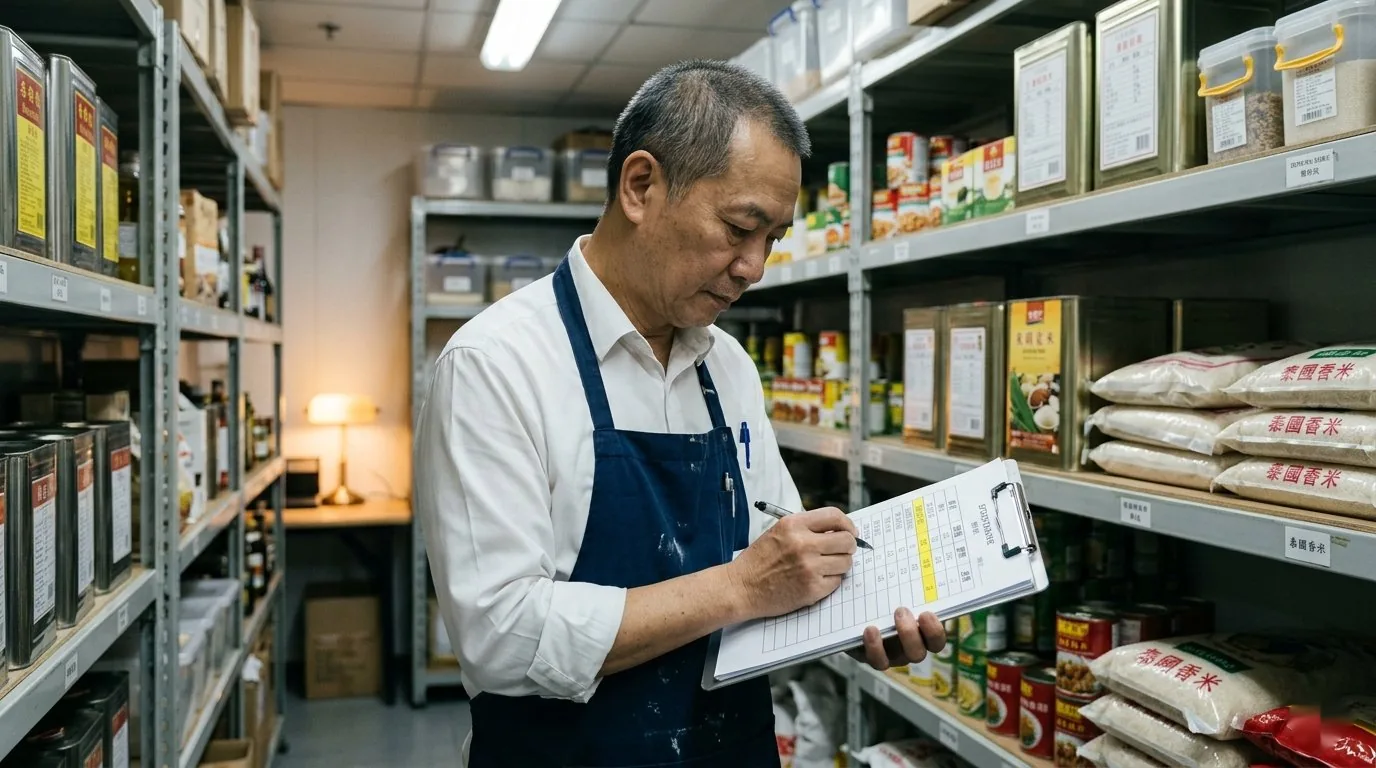
Plenty of restaurant owners find stocktaking a hassle and a time sink — "the kitchen tells me what's low, gut feel is enough". Then they run one proper stocktake and discover the stock the books say should be there doesn't match what's physically on the shelf. The missing part could be wastage, invoicing errors, even internal shrinkage — and you've been in the dark the whole time.
More to the point: if you don't stocktake, every cost figure you have is an estimate. That handsome "30% food cost ratio" could be 5–10 percentage points away from reality — and you'd never know.
A stocktake isn't box-ticking admin. It's the mirror that exposes your problems. This article covers how to do one, how to run the numbers, and how often to do it.
Key Takeaways
- No stocktake, no real costs: that "30% food cost ratio" could be 5–10 percentage points off reality, and you'd never know.
- Variance rate is the tell: (actual cost − theoretical cost) ÷ theoretical cost × 100% — $112,000 actual against $100,000 theoretical is a 12% variance.
- A few points is healthy: cross beyond that and you trace the source — wastage, invoicing errors, or internal shrinkage.
- Start tonight: count your 10 highest-value ingredients after close and compare against theoretical usage.
Why You Must Do Stocktakes
Skip stocktakes and you're estimating cost purely from "how much we bought", with no idea what happened in between:
- Catch wastage and write-offs: which ingredient is disappearing unusually fast?
- Spot internal shrinkage: if book and actual never reconcile, someone may be helping themselves.
- Correct your cost ratio: the gap between theoretical and actual cost is exactly where the problem lives.
- Buy better: only when you know real usage can you order the right quantities and cut overstock.
In one line: without stocktakes, every cost number you have is a guess.
The Core Concept: Theoretical vs Actual Cost
Theoretical cost: how much ingredient you "should" have used, based on recipes and sales.
Actual cost: how much you "really" used, based on the stocktake (opening stock + purchases − closing stock).
Variance rate = (actual cost − theoretical cost) ÷ theoretical cost × 100%
For example: in theory you should have used $100,000 of ingredients, but the stocktake shows you actually used $112,000 — a variance rate of 12%. Healthy restaurants typically keep the variance rate within a few percentage points. The moment it goes beyond that, trace the source.
Stocktake Frequency and Method
Frequency
- High-value, perishable ingredients: weekly
- General ingredients and dry goods: monthly
- The key is a steady, regular rhythm — not a stocktake whenever the mood strikes.
Method
- Count by zone and by category, not everything in one big sweep — that's how items get missed and miscounted.
- Work in pairs, one counting and one recording, to reduce both errors and fiddling.
- Do it at a fixed time (after close or before open, say) to avoid stock moving mid-service.
- Use the same count sheet and the same units every time — otherwise you can't reconcile the numbers or see the trend.
See Your Variance in Real Time, With AI
The most painful part of a manual stocktake is that after the counting comes the calculating, and after the calculating comes the reconciling — punching item after item into a calculator until well past dark. That's the step InvSpot handles with AI: scan a delivery invoice and the system computes your theoretical cost, then reconciles it against the actual cost from your count to surface the variance rate in real time — no Excel, no waiting for month-end — so you see which ingredient is bleeding while there's still time to fix it.
Whichever tool you choose, it should at minimum:
- Calculate theoretical usage and theoretical cost automatically — you only enter the physical counts.
- Work out the variance rate instantly, so anomalous ingredients stand out at a glance.
- Keep a history, so you can see whether the variance rate is improving or deteriorating over time.
The goal is to turn the stocktake from a reconciliation nightmare into a problem-finding tool — the same hours spent, a different level of insight.
FAQ
Stocktakes eat up hours — can the process be simplified?
Yes. Counting by zone and category, a fixed routine, and a tool that does the maths automatically can cut the time dramatically. What matters is doing it regularly, not counting everything in one marathon session.
What counts as a normal variance rate?
It varies by menu, but generally you want it within a few percentage points. What matters is the trend — a sudden spike always means something is wrong.
My shop is small and carries few ingredients — do I still need stocktakes?
Yes. With fewer ingredients, each item's variance has a bigger impact on cost, which makes regular reconciliation even more worthwhile.
Conclusion: The Stocktake Is Your Truth Mirror
Without stocktakes, you are forever guessing whether you're making money or losing it. Do them properly, calculate the variance rate cleanly, and you'll see the wastage, shrinkage and waste you normally can't — and those are precisely the culprits stealing your profit. (Plenty of the shops that closed in the closure wave didn't run out of customers — they simply never saw when they started losing money.) With clear numbers, chasing variance and adjusting purchasing stops being a gamble and becomes a decision you can test and measure.
Start today: pick your 10 highest-value ingredients, count them tonight after close, then compare against theoretical usage. That variance rate is the starting point of your stocktake work.